

The Lansing State Journal reports that “results from [the 2013 National Assessment of Educational Progress, also known as NAEP or The Nation’s Report Card,] show Michigan students scoring below the national average in math and reading.”
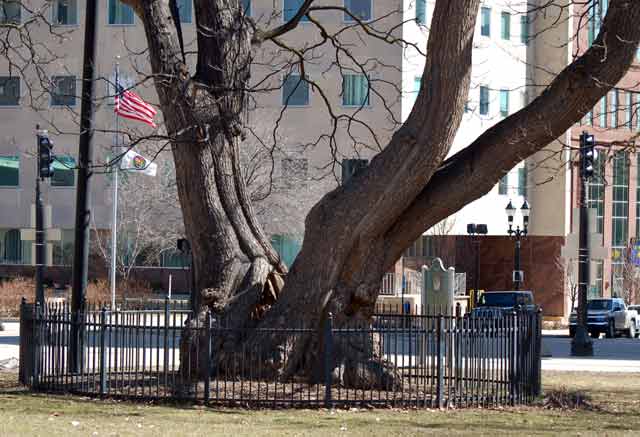
The eastern catalpa tree, Michigan State Capitol, April 5 (Voxitatis)
A closer look at the results shows that Michiganders were performing above the national averages in fourth-grade math between 1996 and 2000, fell to average performance from 2003 through 2007, and have scored below average since 2009, including in 2011 and in 2013, the last year the math test was administered to US fourth and eighth graders.
The decrease in performance in eighth-grade math and in fourth- and eighth-grade reading isn’t quite as dramatic. In fact, Michigan students were right with the national average on the latest eighth-grade reading test and above average on the last eighth-grade science test, which was given in 2011. But school-related people still express concern.
Lying about education with statistics
Because it’s unethical to use test scores to judge the quality of schools or education policies—even scores from NAEP, which is admittedly the longest-running exam given to US students—I have to point out that Michigan’s students are at the mercy of policy makers who say other states are “outpacing” the Great Lakes State in education reform.
“We really are not serving our students in Michigan at the levels that they deserve,” the Journal quoted Amber Arellano, executive director of Education Trust-Midwest, which is based in Royal Oak, Mich., as saying. “That’s really shocking for a lot of people, especially those of us who grew up in Michigan and thought of ourselves as a leading education state.”
Let me just say, I’m disappointed that nobody at the Journal seems to understand how this horse race works. If Michigan’s students aren’t below average, some state’s students are. Scores from Michigan’s students go into the calculation of the national averages, so it’s just dishonest to keep making a race out of test scores. It’s like a dog chasing his tail, which is good if you want to get people to spend money on new curricular materials, textbooks, or standardized tests, but not so good for the dog: there’s no way to win. Some editor printed Ms Arellano’s opinion, which can only be considered disconnected from reality, and I don’t even know where to begin my discussion.
I once wrote that competition is repugnant to the Common Core. Citing statistics that show Michigan coming in at “51st in fourth-grade math improvement, 38th in eighth grade reading improvement, and 39th in eighth-grade math improvement,” as Education Trust-Midwest does, is destructive.
Any kind of competition is repugnant to the Common Core, but when the scores in whatever game we’re playing come from standardized tests, it’s putrid.
Furthermore, the state of Michigan has officially adopted, by act of the state’s duly elected General Assembly, the standards in the Common Core. Who is Ms Arellano to put them in their place? Competition—other than friendly competition—will ruin any efforts to advance otherwise good reforms in standards-based learning.
I explained this fully a long time ago, but it’s not my fault people haven’t read it and are still trying to convince us that public schools in Michigan are “not serving” students. These are fighting words, folks, and I’m sorry the Lansing State Journal gave even an inch to this harmful but scientific-sounding language involving state rankings.
Stop. Ranking. States. Stop. Ranking. Schools. Stop. Making. Students. Compete. Stop. Making. Teachers. Compete. It’s the worst. Idea. Ever. (I figure these uninformed plutocrats will be able to understand if I use really short sentences.)
A real competition that Michigan leads
Let’s instead turn our attention to something positive about Michigan, since the public schools are “obviously” so devoid of positive news. The catalpa tree on the lawn of the State Capitol in Lansing is the biggest tree of its kind in the US, according to the American Forestry Association’s National Register of Big Trees. In 1992, it measured 107 feet tall, 85 feet across the crown, and more than 20 feet around the trunk.
Now that’s a competition worth winning and reporting about! It’s history, and even better, it’s living history.
I acknowledge the hospitality of the people of Michigan and hope someone soon has the sense to stop listening to test scores when proclaiming sweeping generalizations about the public schools in the newspaper. Test scores do not reflect the progress our schools achieve and mask real issues that have not been dealt with for far too long.
The tests used today still measure skills students were learning before that catalpa tree started growing. It was already in the ground when workers started building the Capitol, which was in the 19th century. We need to know how students are progressing on 21st-century skills, and the tests we use don’t even scratch the surface. Furthermore, we need to address the real problems kids face in our schools today, which are absolutely not addressed by standardized tests, even those as well written as the NAEP tests.
