

The biggest show of shooting stars in the year, the Perseids meteor shower, reaches its peak in the early morning Wednesday, August 13, but seeing most of the meteors burning up in the Earth’s atmosphere may be difficult due to the Sturgeon Moon, just past the full moon phase and still bright in the sky, the BBC reports.
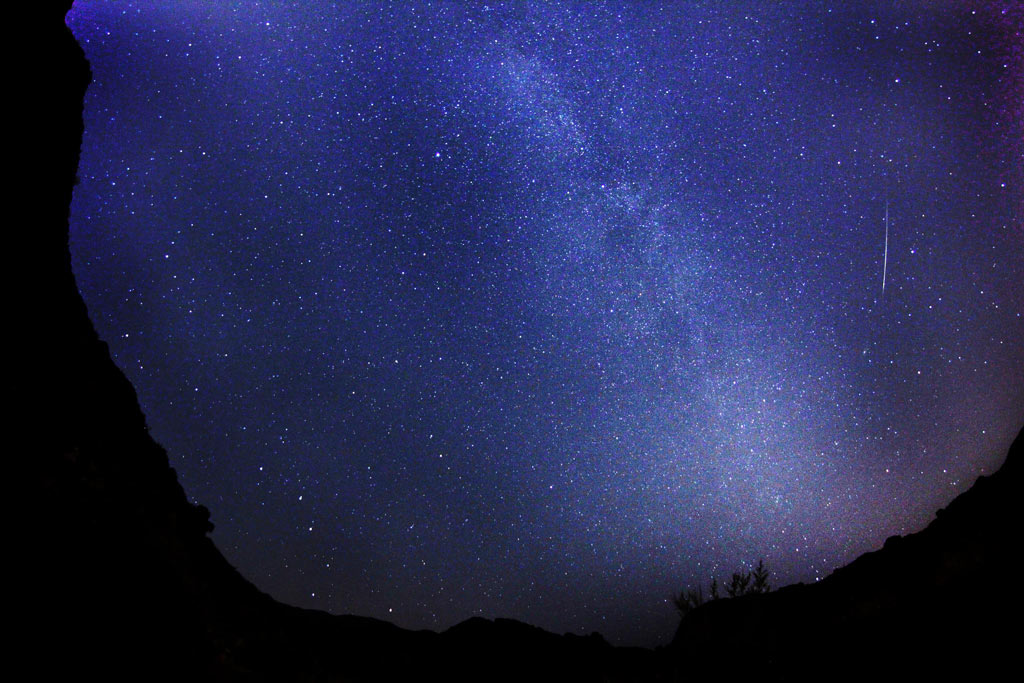 Perseids (Barry Mulling/Flickr Creative Commons)
“This year’s peak unfortunately lines up with a full moon, meaning even in dark sky areas it will be impossible to see the full 100 meteors per hour,” the BBC quoted Finn Burridge, science communicator at the Royal Observatory Greenwich, as saying. “However, [the Sturgeon Moon] is no reason not to go out and enjoy the shower — it is still likely that you will see at least 1 or 2 fireballs per hour, even with a full moon.”
Earth’s annual passage through a trail of debris left by comet 109P/Swift-Tuttle causes the Perseids meteor shower. As these tiny particles enter our atmosphere at high speed, they burn up, creating the streaks of light we see as meteors.
Origin and History
The Perseids are a cosmic phenomenon that has been observed for nearly 2,000 years. The earliest known record dates back to Chinese observers in 36 CE.
The scientific link between the Perseids and a comet was not established until the 19th century. In 1862, astronomers Lewis Swift and Horace Tuttle independently discovered a new comet, which was later named after them. Then, in 1865, Italian astronomer Giovanni Schiaparelli realized that the orbit of comet Swift-Tuttle was nearly identical to the path of the Perseid meteors. This discovery proved that the Perseids are a result of Earth passing through the comet’s debris trail.
Comet Swift-Tuttle is a large comet, with a nucleus about 16 miles (26 kilometers) wide, and it takes approximately 133 years to complete one orbit around the sun. It last passed through the inner solar system in 1992 and will not return until 2125. The debris it leaves behind is a massive cloud of dust and ice. That’s what we encounter every year in late July and August.
In some Catholic traditions, the Perseids are also known as “the tears of St Lawrence,” due to the shower’s peak coinciding with the date of the saint’s martyrdom on August 10.
Some Consider Perseids the Best
The Perseids are often hailed as the best meteor shower of the year for a few key reasons:
Warm Summer Weather: The shower peaks in mid-August in the Northern Hemisphere, which means skywatchers can comfortably observe the event without having to bundle up in cold weather.
High Meteor Rates: Under ideal conditions (a dark sky with no moon), the Perseids can produce a high number of meteors, often between 60 to 100 per hour. While other showers like the Geminids can sometimes produce more, they occur during colder, often cloudier, winter months.
Bright Meteors and Fireballs: The Perseids are known for producing a significant number of bright meteors and fireballs. These are larger, brighter explosions of light and color that can persist longer than average meteors, making for a spectacular show, even with some light pollution, as we’ll surely get this time around.
