

You are what you eat — even if your last meal was 150 million years ago.
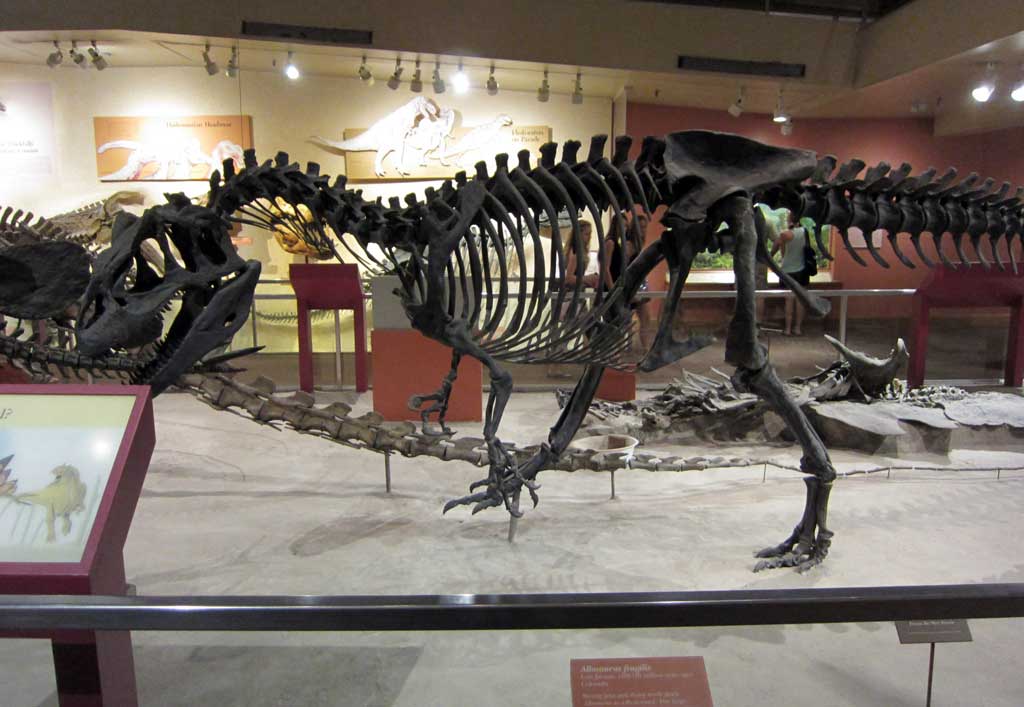 Allosaurus (Jason and Tina Coleman/Flickr Creative Commons)
By studying the chemistry of tooth enamel, scientists at the University of Texas at Austin have uncovered evidence that Jurassic dinosaurs divided up their meals in surprising ways. Some preferred buds and leaves, others woody bark, and still others a mixed menu. This dietary diversity, researchers say, helped massive plant-eaters coexist while predators carved out their own niches.
Research is published in Palaeogeography, Palaeoclimatology, Palaeoecology.
“The ecosystem that I studied has been a mystery for a long time because it has these giant herbivores all coexisting,” said lead author Liam Norris, a recent UT doctoral graduate. “The idea is that they were all eating different things, and now we have found proof of that.”
Norris analyzed teeth from 17 individuals across five species found in a single quarry in northeast Utah, preserved during a short, extreme drought. The plant-eaters included the long-necked Camarasaurus, the short-armed Camptosaurus, and the trunk-legged Diplodocus. The carnivores were the towering Allosaurus and the smaller, crocodile-like Eutretauranosuchus.
The findings reveal that Camptosaurus preferred soft, nutritious leaves and buds; Camarasaurus chewed conifers and woody tissues; and Diplodocus ate a broader diet of ferns, horsetails, and tougher plants. “This differentiation in diet makes sense with what we see from the morphology of these animals: the different height, the different snout shape,” Norris said. “Then, we bring in this geochemical data, which is a very concrete piece of evidence to add to that pot.”
Carnivores, too, showed dietary distinctions. Both Allosaurus and Eutretauranosuchus overlapped in isotope values, but evidence suggests that the crocodile-like reptile ate fish, while Allosaurus preyed mainly on herbivorous dinosaurs, possibly including its plant-eating quarry mates.
By showing how so many giants survived side by side, the research paints a vivid picture of a productive Jurassic ecosystem. “It’s really just more proof that this ecosystem was as spectacular as we thought it was,” Norris said.
