
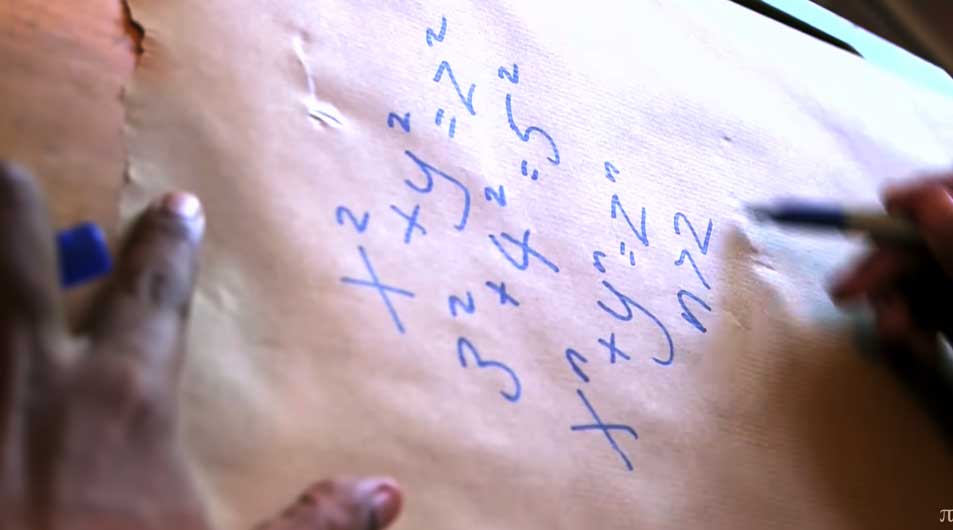
Writing in the student newspaper at The Bronx High School of Science in The Bronx, New York, Valeria Savin tells the fascinating story of how Sir Andrew Wiles solved “Fermat’s Last Theorem.” The theorem states that there exist no whole numbers for x, y, and z such that

where

In the article, Valeria calls it the “proof that never starts or ends”: “Mathematicians find themselves drawn to Fermat’s Last Theorem because of its rich history,” she writes. “It is seen as a challenge, an invitation, the ghost of what used to be a French mathematician alluring the living to a game and haunting all his players.”
Pierre de Fermat, the French mathematician Valeria refers to, famously wrote in the margin of a book that he had discovered a “truly marvelous proof,” but added that the margin was “too narrow to contain it.” Most modern mathematicians believe Fermat was likely mistaken about having a complete proof, as the math required to solve it hadn’t been invented yet.
How Andrew Wiles Proved It
Sir Andrew Wiles finally proved the theorem in 1994 (published in 1995) after working in near-total secrecy for seven years. He didn’t attack the equation directly; instead, he used a massive “bridge” between two completely different areas of mathematics.
1. The Strategy: Proof by Contradiction
Wiles used a strategy developed by mathematicians Gerhard Frey, Jean-Pierre Serre, and Ken Ribet. They showed that if Fermat’s Last Theorem were false (meaning a solution did exist), that solution could be used to create a very weird, specific mathematical object called an elliptic curve.
2. The Link: The Modularity Theorem
The key was the Taniyama-Shimura-Weil Conjecture (now the Modularity Theorem). This conjecture suggested that every elliptic curve is linked to a “modular form” — a complex, symmetric type of function.
The logic was this: If Wiles could prove the Modularity Theorem, he would prove that all elliptic curves must be modular.
The contradiction: Ribet had already proved that the “Fermat elliptic curve” (the one that would exist if Fermat was wrong) was so strange that it could never be modular.
3. The Climax
By proving that these elliptic curves are indeed modular, Wiles showed that the “Fermat curve” could not exist. If the curve cannot exist, then the solution to the equation cannot exist. Therefore, Fermat’s Last Theorem must be true.
Wiles’s proof is over 100 pages long and relies on 20th-century tools like Galois representations and Iwasawa theory, which are far more advanced than anything available in the 1600s.
This 10-minute documentary details Wiles’s personal journey and the intense mathematical “marathon” he ran to solve the mystery.