

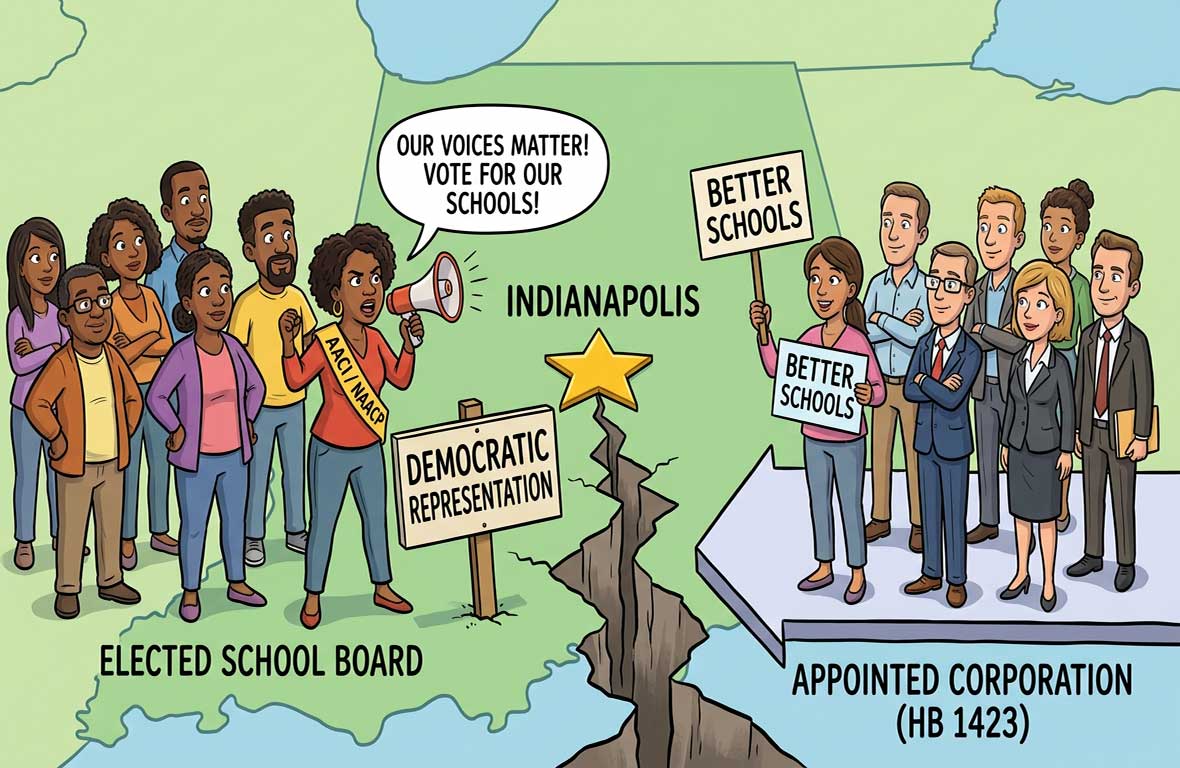
The legislative landscape for Indianapolis Public Schools (IPS) is currently undergoing a significant and controversial transformation. At the center of the debate is House Bill 1423, a measure that would effectively bifurcate the governance of the city’s largest school district, Chalkbeat Indiana reports.
The Proposed Governance Overhaul
If passed, HB 1423 would create a new entity called the Indianapolis Public Education Corporation (IPEC). This body would be appointed by the Mayor of Indianapolis rather than elected by the public.
The new corporation would take control of essential district operations, including transportation, facilities management, and property tax collection and levying. The current elected IPS school board would retain authority over academics and staffing but would lose its power over the district’s “business” side and physical assets.
The IPEC would be tasked with creating a unified accountability framework for both district and charter schools. This framework would have to include a requirement to close chronically underperforming schools.
Timeline and Financials
Because transferring debt-financed buildings is complex, many of the corporation’s duties are slated to begin in the 2028-2029 school year.
The bill allows the corporation to use up to 3% of property tax revenues (approximately $3 million) to fund its executive director, staff, and consultants. Notably, the bill would exempt IPS from the current Indiana law that requires districts to sell underutilized buildings to charter schools for $1, instead placing those buildings under IPEC management.
Student Demographics and Current Leadership
The impact of this overhaul falls on a district that is primarily composed of students of color and is currently led by a historic administration: its first-ever school board consisting entirely of women of color and the district’s first Black female superintendent. Opponents of the bill argue that diluting the power of this board effectively disenfranchises the voters who placed them in office.
IPS Student Enrollment (by Race/Ethnicity):
- Black Students: ~38%
- Latino Students: ~37%
- White and Other Students: ~25%
Diverging Perspectives on Outcomes
The debate in Indianapolis often centers on whether charter schools or traditional district schools provide better outcomes for Black and Latino students.
While reform advocates contend that charter schools provide better environments and outcomes for marginalized students, the African American Coalition of Indianapolis and National Association for the Advancement of Colored People argue that structural changes should not come at the cost of democratic transparency and elected representation.
And although Black and Latino charter school students often score higher on the state’s standardized tests than their IPS peers, proficiency rates across all Indianapolis school types remain largely below the statewide average.
The “Monolith” Debate
A central point of tension involves the representation of Black parental sentiment. While some reform organizations claimed that parents of color broadly support the bill to escape underperforming district schools, the AACI and the Greater Indianapolis NAACP have formally opposed it.
They argue that Black parents are “not a monolith” and that removing power from an elected board in a majority-minority district “reeks of paternalism.”
