

Greek mathematicians in the Pythagorean School were probably the first to discover that some numbers could not be represented by a whole number divided by another whole number, as these three numbers could:

These were the same Greeks who came up with the Pythagorean Theorem, which says that the square of the hypotenuse of a right triangle is equal to the sum of the squares of the two shorter sides. The theorem is often written as follows:
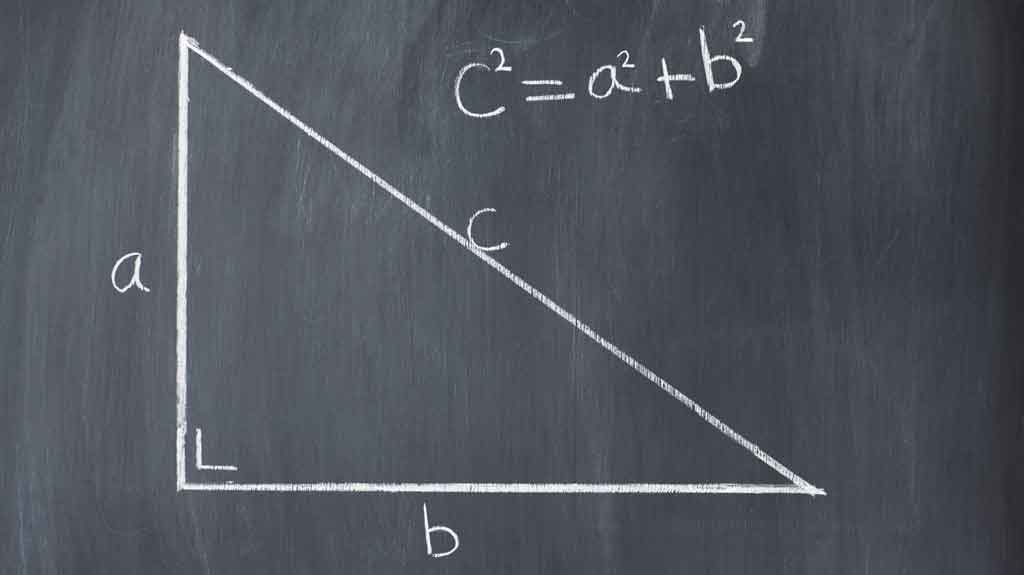
Specifically, for the isosceles right triangle (45° base angles) with sides of length 1, the length of the hypotenuse didn’t appear to be a nice rational number. (Rational numbers are those that can be represented by the quotient of two whole numbers.)

In other words, it looked as if 
The proof that the square root of 2 is not a rational number but is, in fact, an irrational number is one of the classic proofs in mathematics and, since it’s not too hard to follow, can be a useful sequence to commit to memory for its own sake. But more important, perhaps, is how the methodology behind the proof is often used across all areas of mathematics, logic, science, and in some cases, the law. It’s known as a proof by contradiction.
Proving that the square root of 2 is not a rational number—at least one way to prove it—is to start with the assumption that it is a rational number and work through with that supposition until you encounter a mathematical statement that couldn’t possibly be true or violates the initial supposition.
Consider proving that three of any 15 calendar days must fall on the same day of the week. For example, if I choose the first 15 days in August, my theorem says that three of them must be on the same day of the week. For this month, that day is a Saturday, which occurs on Aug 1, 8, and 15. But let’s use the general case.
To prove this “theorem ” by contradiction, we would start with the supposition that three days don’t fall on the same day of the week. That is, at most two days fall on the same day of the week.
It’s a fact that there are seven days in a week, which implies that only 14 days (2 × 7) can be chosen. If the 14 days were consecutive, all seven days of the week would have two days under this arrangement.
That represents a contradiction, since we had to consider 15 days in the original hypothesis. Adding any more days would be impossible, since the days of the week are already at their maximum load of two under the supposition. Thus, by showing that the converse of the theorem in question couldn’t possibly be true, what is left is the truth.
The same goes for proving the square root of 2 is an irrational number. Start by supposing the square root of 2 is rational, meaning it can be represented by the quotient of two whole numbers:

where a and b are natural numbers. We also know that a/b must be in its most reduced form, since if a and b have any factors in common, they would simply cancel out.
| |
(1) Supposition (assert a and b have no common factors) |
 |
(2) Algebra (square both sides, ignore extraneous) |
 |
(3) Algebra (exponent) |
 |
(4) Algebra (multiply both sides by b2) |
 |
(5) It’s divisible by 2 |
 |
(6) It’s equal to an even number |
 |
(7) a2 would be odd if a were odd |
 |
(8) Even numbers are multiples of 2 |
 |
(9) Replace a in Step 4 |
 |
(10) Algebra (exponent; divide both sides by 2) |
 |
(11) Even numbers are multiples of 2, so 2c2 is even; (7) |
 |
(12) If both a and b are even, they have a common factor of 2. |
Prove that the following statements are always true (i.e., for every rational or irrational number in existence), sometimes true, or never true:
- The sum of two rational numbers is rational.
- The product of two rational numbers is rational.
- The sum of a rational number and an irrational number is irrational.
- The product of a rational number and an irrational number is irrational.
Use mathematics in your explanations and note that the last one’s a trick question. See Common Core high school math standard HSN.RN.B.3 for more information.
