Evolutionary convergence in 2 distant deserts By Paul Katula • Aug 8, 2017 Why do 2 plants from different parts of the world have similar characteristics or traits? It's natural selection & convergent evolution.
Music has always been a part of being human By Press Release • Aug 8, 2017 What is music? How and why did music become such an important part of our lives? Does it predate speech? More reason to keep music programs strong.
Better to teach genetics before evolution By Press Release • May 26, 2017 Getting students to understand a tough concept like evolution could be better if you teach them the fundamentals of genetics first.
On Charles Darwin’s 208th birthday By Paul Katula • Feb 12, 2017 Today is Charles Darwin's birthday, and we celebrate it by talking about the intersection of science, religion, the care of our planet, and technological advances.
Do genes predict how we use social media? By Press Release • Jan 23, 2017 How we interact with social networks—look at info that reinforces or confronts our own viewpoint—may depend on our genes.
Mutations in ‘essential’ genes linked to autism By Press Release • Dec 14, 2016 Mutations in those genes that are essential to life have been linked to autism in a huge review of family data in a few huge databases. From U.Penn.
One little mutation can mean so much By Press Release • Nov 16, 2016 How did unicellular organisms become multicellular? It could come down to a single mutation 600 million years ago in their DNA.
Sibling rivalry seen in some birds By Press Release • Nov 8, 2016 Did you know some birds are more likely to exaggerate their need for food if their parents are likely to breed again (or if they already have).
Spooky science stories for Halloween: NYT & others By Paul Katula • Oct 30, 2016 Science experiments sometimes get a little spooky, fascinating, or just plain creepy. Just in time for Halloween, here are a few collections.
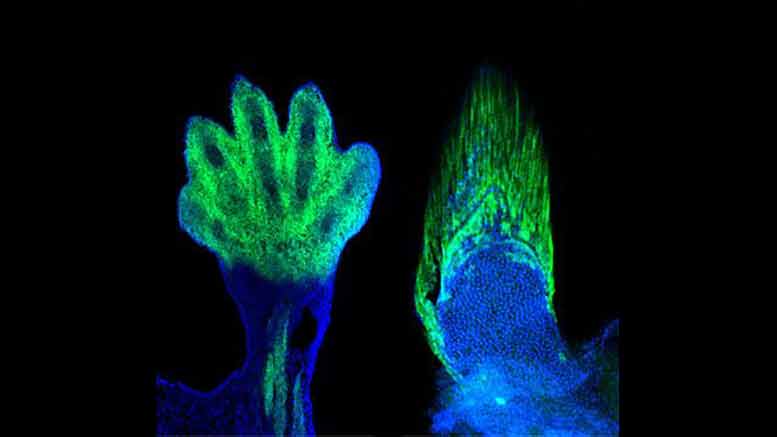
How fish fins evolved to become fingers By Paul Katula • Aug 20, 2016 New research out of the University of Chicago provides insight into one of the most important evolutionary developments for humans: fingers.