INDIANAPOLIS (Nov. 14, 2009)—Ten years ago, scientists Jacquelynne Eccles and Bonnie Barber published the landmark article, “Student Council, Volunteering, Basketball, or Marching Band: What Kind of Extracurricular Involvement Matters?” (J. Adol. Res. 14: 10). And five years ago, the marching band from West Bloomfield High School in West Bloomfield, Mich., was one-third the size of what it is here today, in semi-final competition at the Bands of America Grand National Championships.
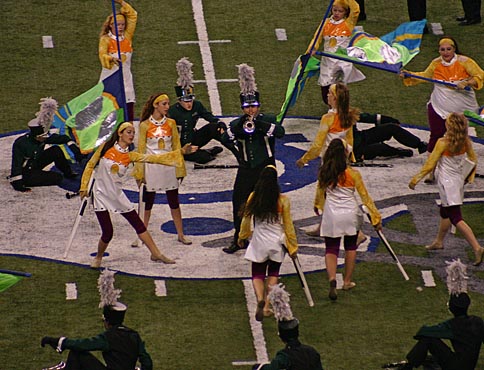
Still, the school’s enrollment of about 1,954 students in grades 9-12 and marching band size of 123 give it a 6.3-percent participation rate. That’s probably among the lowest rates here today, but five years ago, things were much worse.
Enter band director, Arthur Ebert.
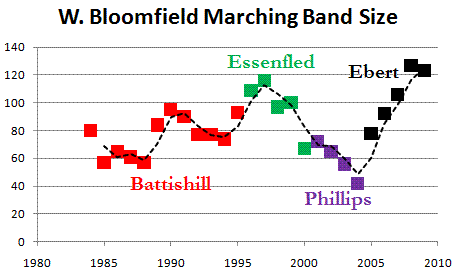
This line graph shows the number of students participating in the band since 1984, under directors Curt Battishill (red, 1984-1995), Mark Essenfled (green, 1996-2000), Mark Phillips (purple, 2001-2004), and Mr. Ebert (black, 2005-2009).
While Mr. Phillips’s shows had titles like “Planets,” “Reflections of the Rolling Stones,” “Urban Sketches,” and “Queen,” Mr. Ebert has used field show titles as a newspaper editor would use headlines. His shows have had titles like “Brother, Can You Spare a Dime?” and “Alone … in a Crowd.”
This year’s creation, entitled “Tommy,” continues to spark our interest and, more importantly, the interest of his students. Just as headlines sell newspapers, the artistic theme of a marching band show can help create an environment in the band that’s more fun to be around. When students are having more fun with the show, participation levels are sure to increase over time.
American musicologist and composer Heidi Von Gunden described the process of music composition in a series of lectures, based on her studies of contemporary composers like Ben Johnston, Pauline Oliveros, Lou Harrison, and Vivian Fine. In those lectures, she said the first thing she does for a new piece is “come up with a title.” From that, everything else flows.
And for marching bands, the “everything else” would be the fun and entertainment, the elliptical arcs drawn on the field, the musical climax and the show’s dramatic, soft ending, the costumes and designs on the flags, and so on—all things that go into great performances, from booking travel to exciting and new places to building traditions of excellence.
It’s hard work. Once word gets out that marching band is a fun activity, though, even songs like “Tommy, Can You Hear Me?” from The Who, with its simple lyrics, can blossom into a national-class marching program:
Tommy, can you hear me?
Can you feel me near you?
Tommy, can you see me?
Can I help to cheer you?
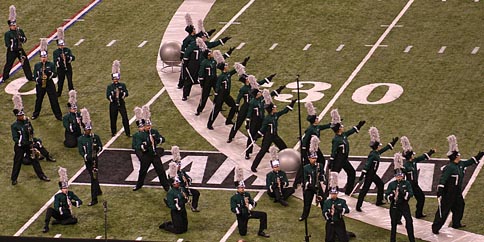
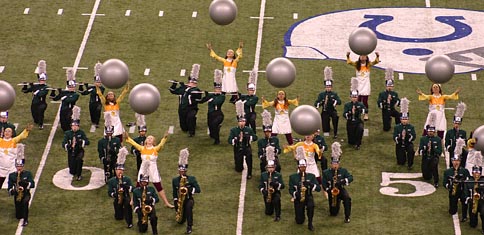
As the lyrics state, band members need something to cheer Tommy on about. That would be pinball, and it comes just after saxophone and flute soloists provide smooth segues to the final movements.
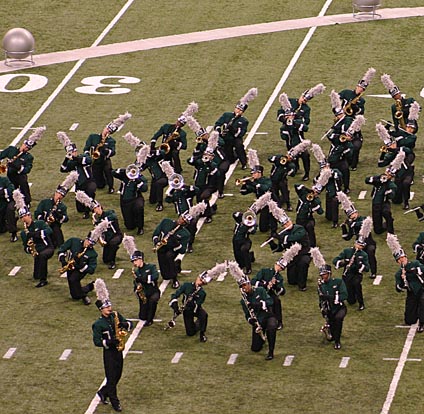
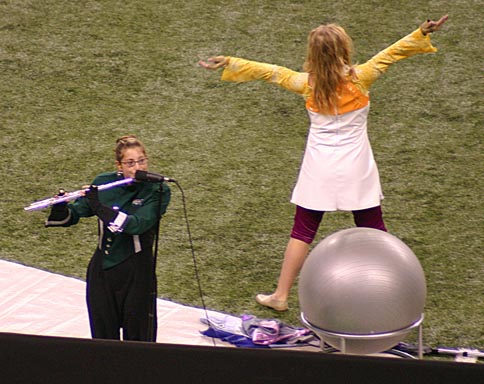
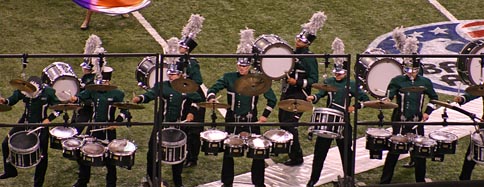
“Pinball Wizard,” also by The Who, tells us that Tommy “sure plays a mean pinball.” Dancers use the huge silver balls as props, and drummers provide the sound effects from inside the arcade, turning cacophonous hammering into music.
Why performing arts participation is powerful
The study cited above showed that 10th and 12th graders who took part in band or orchestra “were less frequently engaged in risky behaviors” than those who did not take part. However, other variables affected the analysis, and the study’s authors said results were only significant for 12th graders.
But other interesting findings resulted from the study—such as, students who participated in the performing arts liked school better and tended to have higher GPAs by 12th grade. They were also more likely to be in college at age 21.
The West Bloomfield Laker Band is directed by Mr. Ebert and led on the field by drum majors Julie Clark and Jenn Clawson. Participation levels for band and orchestra among high school students in the United States is estimated to be between 15 and 20 percent, with slightly higher levels for girls than boys.
Link to all semi-final bands:
2009/11/15/bands-of-america-semi-finalists
Comments are closed.