

The rapid integration of generative AI into K-12 classrooms has sparked a fundamental debate over the nature of education itself.
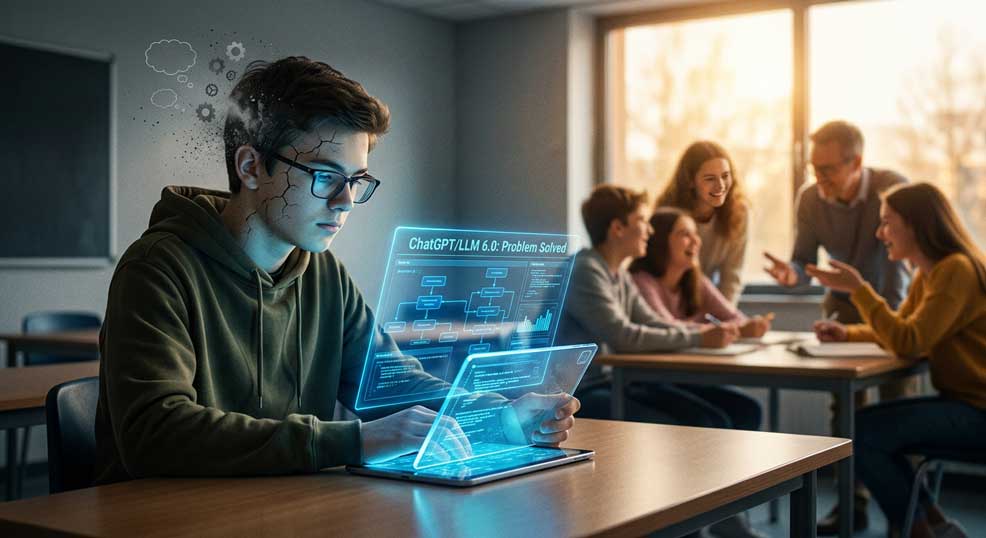
Writing in the student newspaper at Paschal High School in Fort Worth, Texas, Walter Aston reports that students acknowledge that tools like ChatGPT can simplify complex topics. But a new report from the Center for Democracy and Technology, reported by Education Week reveals a stark trade-off: 50% of students admit that using AI in class makes them feel less connected to their teachers. As AI begins to handle tutoring and even mental health queries, the vital “human-to-human” feedback loop that defines a supportive classroom environment is at risk of being replaced by a sterile machine interface.
This technological shift highlights a growing tension between “knowing” and “learning.” As Robbie Torney of Common Sense Media points out, Large Language Models (LLMs) are designed for speed and task completion—essentially bypassing the work to get to the result. However, the true process of learning is inherently slow and laborious; it requires a student to start from “square one,” struggling with new concepts and refining their own critical thinking.
When AI provides instant summaries or drafts, it removes the “productive struggle” necessary for a student to internalize knowledge and develop an original voice.
The concern among educators is that an overreliance on these shortcuts will atrophy essential cognitive skills. According to the report, 70% of teachers worry that AI is actively weakening students’ research and critical thinking abilities. If a student uses an LLM to skip foundational steps in analysis and problem-solving, they may arrive at a factual answer without ever understanding the “why” or “how” behind it. This creates a surface-level literacy where students may “know” facts but lack the deep, independent thought required to apply them in new contexts.
Furthermore, the “human-machine conversations” that now dominate student workloads are increasingly occurring in a vacuum. Teachers and parents alike have expressed concern over the decline in peer-to-peer and student-teacher interactions. When the “labor” of learning, including the drafting, the failing, and the revising, is outsourced to a bot, the opportunities for a teacher to mentor a student through their specific intellectual hurdles vanish. Without that intervention, the teacher is relegated to the role of an “AI auditor,” spending more time verifying authenticity than nurturing a student’s unique potential.
Ultimately, the future of AI in schools depends on a shift in focus from “efficiency” to “literacy.”
Experts suggest that schools must move away from the “hype” of fast results and instead implement guardrails that treat AI as a secondary support rather than a primary instructor. By prioritizing the teacher-student bond and protecting the “slow” process of learning, schools can ensure that technology serves as a ladder for intellectual growth rather than a replacement for the human mind.
