

The implementation of the 2025 executive order “Restoring Truth and Sanity to American History” has sparked a profound conflict within the National Park Service, as officials struggle to reconcile factual historical interpretation with a mandate to avoid “denigrating” American figures.
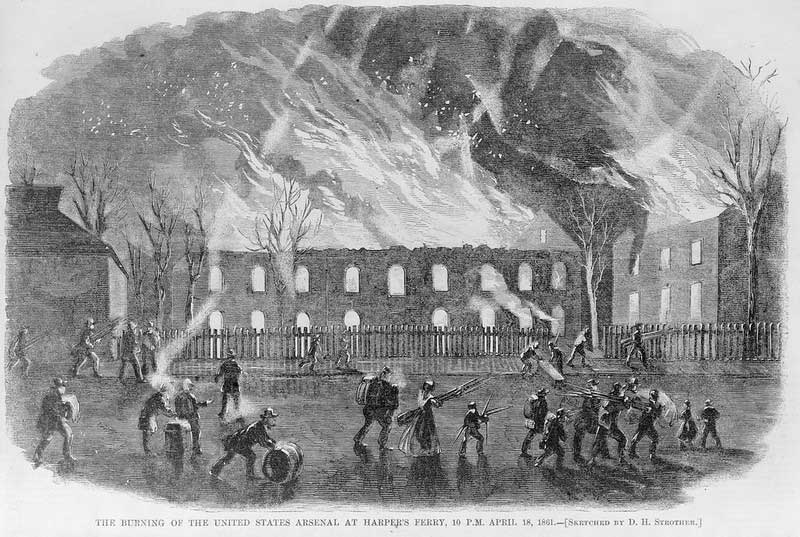 Harper’s Ferry burns, by DH Strother (Allen Gathman via Flickr Creative Commons)
According to an internal database reviewed by The Washington Post, hundreds of sites, ranging from the Emmett Till National Monument to Arches National Park, have flagged exhibits for review. The directive prioritizes depictions of “grandeur” and “beauty,” leading to the removal or recasting of materials regarding slavery, segregation, and climate change to ensure they do not “disparage” historical actors or contemporary sensibilities.
This federal scrubbing mirrors a broader, ongoing debate in US education over the “Lost Cause” narrative and the “whitewashing” of history.
In many states, legislative efforts have sought to limit classroom discussions on systemic racism and “divisive concepts,” often under the guise of protecting students from discomfort. National park sites like Harpers Ferry and the Selma to Montgomery Trail find themselves in the same crosshairs. Staffers have questioned whether citing primary source documents, including Confederate secession papers that explicitly name slavery as the cause of the Civil War, violates the administration’s ban on “partisan ideology.”
The legal and social pushback has been immediate, highlighting a fundamental divide in how Americans believe history should be taught. A federal judge recently compared the removal of slavery-themed panels in Philadelphia to the state-sponsored “mind control” in Orwell’s 1984, ordering their immediate restoration. This judicial intervention aligns with the perspective of professional historians and organizations such as the Association of National Park Rangers, who argue that a “sanitized” history is not history at all but rather a form of censorship that denies the public the opportunity to learn from “dark periods” of the American past.
For sites like Manzanar National Historic Site, which commemorates the incarceration of Japanese Americans, or the home of Medgar Evers, the executive order poses an existential threat. These locations exist specifically to interpret painful, unidealized moments of the American story. Critics argue that if interpretation is limited only to “progress” and “greatness,” the specific struggles of minority groups, which constitute a massive portion of the American experience, are effectively erased.
Ultimately, the conflict reflects a deeper struggle over the “purpose” of public lands and education.
While some proponents argue that the order restores a narrative that honors America’s founding, opponents see it as a political attempt to retrofit the past. As lawsuits move through the courts, the primary concern for educators and rangers remains the integrity of the information provided to the public. If accurate, primary-source-backed history is replaced by “pablum,” the next generation of students may lose the critical thinking skills necessary to understand the complexities of their own national identity.
