

The traditional understanding of Attention-Deficit/Hyperactivity Disorder (ADHD) is undergoing a significant transformation as new research challenges the idea that the condition is strictly a “lack of attention.”
Recent data published in the scientific journal Cell shows that ADHD diagnoses are rising sharply, with approximately 11% of American children now identified as having the disorder. While the public often associates ADHD with outward hyperactivity, experts now recognize that many students struggle with “inattentive” symptoms, such as disorganization and a lack of focus, without ever exhibiting disruptive or impulsive physical behaviors.
A groundbreaking 2025 study from Benjamin P Kay and colleagues at the Washington University School of Medicine has shifted the scientific focus from attention spans to “reward circuitry.”
By using advanced brain imaging on thousands of children, researchers discovered that ADHD medications primarily target the brain’s alertness and reward networks rather than the areas associated with sustained attention. This suggests that the struggle for students with ADHD isn’t necessarily an inability to pay attention, but rather a “selective” focus. These students can often hyperfocus on high-interest activities like video games because those tasks provide the constant, immediate feedback their brains crave.
This biological “wiring” for immediate gratification helps explain why the traditional classroom environment can be so challenging for students with ADHD. In a phenomenon known as “delay aversion,” these students often find the slow pace of schoolwork and the lack of immediate rewards to be physically and mentally taxing.
While most students can work toward a distant goal like a quarterly report card, the ADHD brain is often drawn to novelty and instant feedback, making long-term, effortful tasks feel uniquely “boring” or intolerable compared to the rapid-fire stimulation of digital media.
To bridge this gap, educators are being encouraged to rethink how they deliver content and provide feedback. Instead of relying on long-term rewards, experts suggest using “daily report cards” or immediate positive affirmations that tie back to specific, clear goals.
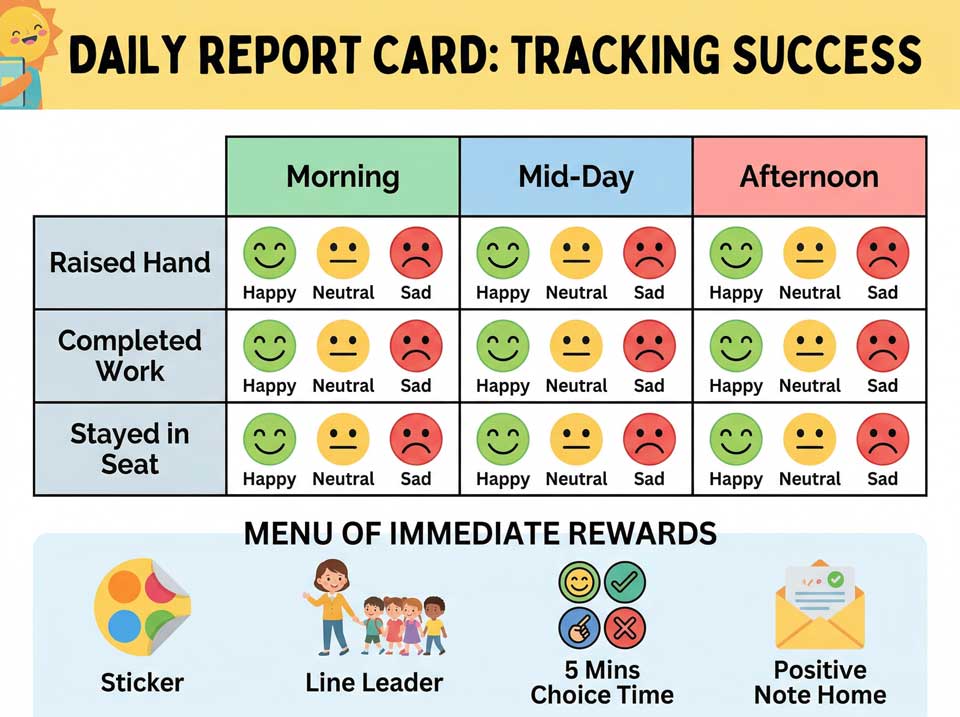 A sample “Daily Report Card” for elementary students with ADHD
By shortening the time between a student’s effort and their reward, teachers can help students with ADHD stay engaged. Furthermore, aligning lessons with real-world experiences—such as internships or hands-on STEM projects—can provide the novelty and relevance needed to capture a student’s selective attention.
Ultimately, the goal for modern educators is to compete with an increasingly digital world that provides constant, low-effort rewards. By understanding that ADHD is a reward-based disorder rather than a simple lack of willpower, teachers can move away from punitive measures and toward structural changes.
Implementing high-interest, high-novelty lessons and frequent, objective feedback allows students with ADHD to navigate the school day more successfully, turning the classroom into an environment where their unique brain chemistry can thrive rather than struggle.
