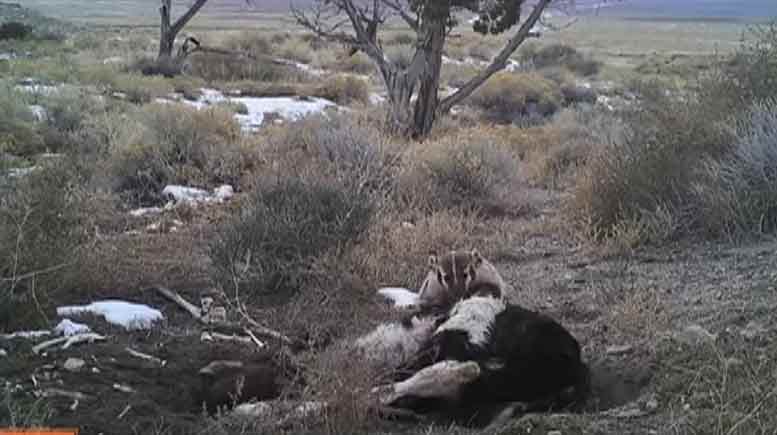
A badger buries a cow in Utah, all by itself By Press Release • Apr 1, 2017 We know a little more about how scavengers cache their food supply in the Utah desert, thanks to some biologists at the University of Utah.
How important is the ‘GPS’ in your brain? By Press Release • Apr 1, 2017 The hippocampus has long been known to be associated in the brain with our sense of direction or mapping the environments we navigate.
Is Trump at war with science? By Paul Katula • Mar 27, 2017 We wonder, along with many people, why the president seeks to cut funding for basic scientific research in favor of the military.
To manage an ecosystem, look at predators & prey By Paul Katula • Mar 22, 2017 When policymakers decide how to manage wildlife, they look at many factors; sometimes one of those factors is entertainment.
Student science experiments going to space station By Paul Katula • Mar 9, 2017 If we're planning to go back to the moon, to Mars, or beyond, we need some basic science experiments to pave the way for long space flights.
A single protein may be at the root of autism By Press Release • Mar 8, 2017 Researchers are closer than ever to finding a cure for Fragile X syndrome, a leading cause of autism. A single protein may hold the key.
Head injury can lead to genetic changes in brain By Press Release • Mar 7, 2017 A traumatic brain injury could alter master genes and increase your risk of developing certain brain diseases, like ADHD, Alzheimer's, and autism.
Math could help us understand our bodies, disease By Press Release • Mar 3, 2017 Scientists from Berkeley and Mich. develop a model from a math perspective for how genes are expressed in different cells at different stages.
Danville students go to work on balloon festival By Paul Katula • Feb 28, 2017 A class of elementary students from Danville, IL, will serve as ambassadors and designers for a part of a hot-air balloon festival. Homework required.
Nearby star has 7 Earth-sized planets: NASA By Press Release • Feb 22, 2017 Are we alone? NASA scientists have published their discovery of 7 Earth-sized planets orbiting a red dwarf star that's only 39 light years away.