A recent settlement between the Maryland Attorney General and the US Department of Education marks the conclusion of a high-stakes standoff over the intersection of federal funding and state-level education policy, The Baltimore Banner reports.
At the heart of the conflict was a federal directive requiring school districts to certify adherence to a specific interpretation of Title VI of the Civil Rights Act. The interpretation by the federal government argued that Diversity, Equity, and Inclusion (DEI) programs effectively discriminated against white and Asian American students.
Maryland, alongside 18 other states, challenged this, leading to a legal battle that threatened approximately $700 million in federal resources earmarked for the state’s most vulnerable populations. The resolution preserves critical funding for Maryland’s English language learners, students with disabilities, and children from low-income families.
While most Maryland districts stood firm against the federal mandate, Somerset County was the notable exception, initially agreeing to the administration’s interpretation.
State Superintendent Carey Wright navigated the crisis by maintaining that Maryland schools already comply with civil rights laws as established by legal precedent, a measured stance that allowed the state to defend its curriculum, including AP African American Studies, without immediate financial collapse.
Students and Diversity, Equity, and Inclusion
Writing in the student newspaper at Arlington High School in Washington State, sophomore Audrey Lembke suggests that the heart of cultural exchange isn’t just about representing one’s own background, but rather about an active, curious engagement with the world around us. By prioritizing the “will to learn” over personal heritage, the school’s Diversity Club shifts the focus from individual identity to a collective commitment to inclusion and community building.
This philosophy of curiosity-driven community is echoed by fellow students who see initiatives like Diversity Clubs and cultural electives as a way to bridge gaps between different social groups. Audrey quoted a fellow student in her article:
In addition, as reported by Mia Guarino in the student newspaper at Huntley High School in Illinois, DEI-centered electives are actively encouraged by students, even if the school can’t yet offer them as classes. American Sign Language, for instance, “is the most requested future class for Huntley High School,” Mia writes. “Surrounding schools in the Fox Valley Conference offer the class taken as a world language.” She quotes one junior as saying, “If people become more aware of [ASL], it will become more normalized.”
Together, these perspectives highlight a growing trend in secondary schools where student-led organizations are moving beyond mere “awareness” and toward active, empathetic participation in global and local social issues.
National Context: The Weight of Federal Funding
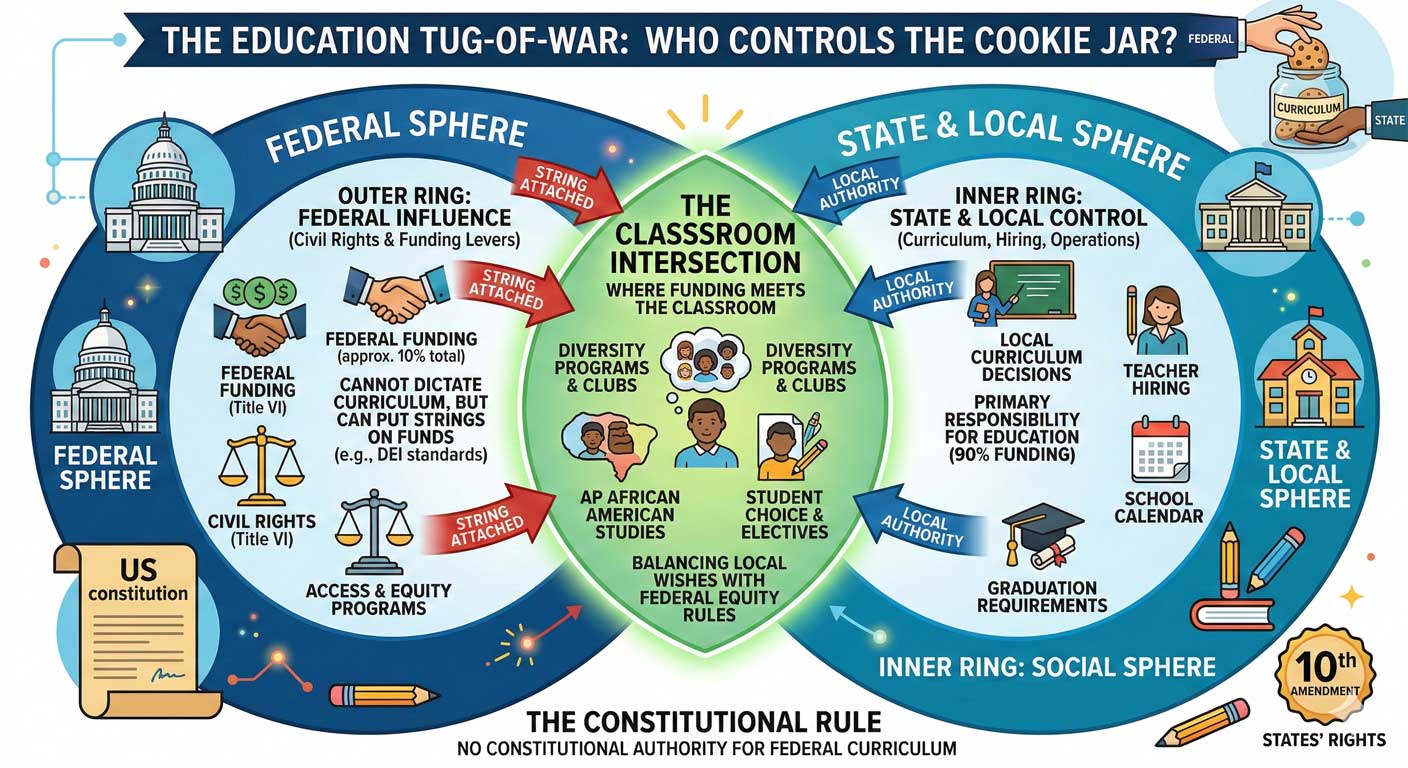
The federal settlement is also a landmark case in the ongoing debate over “federalism” in education. It establishes a significant legal shield for states to maintain localized control over curriculum and diversity initiatives.
Had the federal government succeeded in withholding these funds, it would have set a precedent allowing Washington to use the “power of the purse” to dictate specific classroom content and hiring practices nationwide. Instead, the court’s ruling and the subsequent dropped appeal reinforce the authority of state education departments to define their own equity standards.
To understand the scale, it’s helpful to look at how federal money typically flows into state education systems like Maryland’s:
- The $700 Million Impact: In Maryland, federal funding typically accounts for about 6% to 9% of the total education budget. While that may seem small compared to state and local shares, these funds are “categorical,” meaning they are legally locked in to support specific groups.
- Title I and IDEA: The majority of the threatened $700 million falls under Title I (supporting schools with high concentrations of poverty) and the Individuals with Disabilities Education Act (IDEA). For many Title I schools, federal dollars cover the salaries of reading specialists and the costs of supplemental nutrition programs.
- A National Trend: Maryland was one of 19 states involved in the lawsuit. Nationwide, the federal government contributes about $79 billion annually to K-12 education. This case was viewed as a “test balloon” to see if that $79 billion could be leveraged to eliminate DEI programs in blue and purple states.