
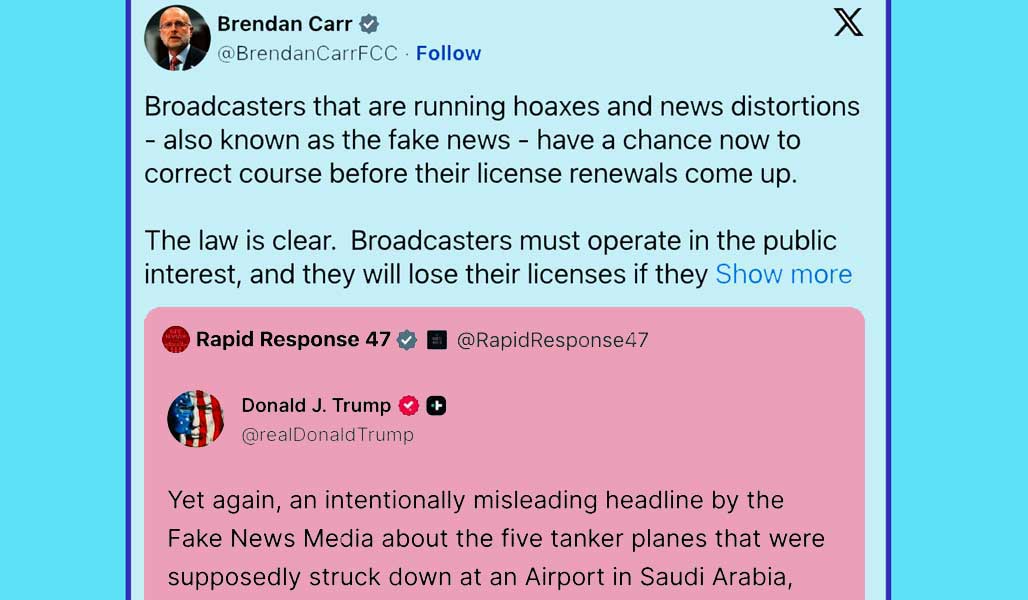
Federal Communications Commission (FCC) Chairman Brendan Carr issued a direct warning yesterday to American broadcasters, stating that stations deemed to be running “hoaxes and news distortions” risk having their federal licenses not renewed. The statement, posted to social media, was a direct response to a Truth Social post by President Donald Trump, who had earlier criticized major media outlets for their reporting on the ongoing conflict in Iran.
Broadcasters that are running hoaxes and news distortions – also known as the fake news – have a chance now to correct course before their license renewals come up.
The law is clear. Broadcasters must operate in the public interest, and they will lose their licenses if they… https://t.co/7bBgnsbalw
— Brendan Carr (@BrendanCarrFCC) March 14, 2026
The “Correct Course” Directive
Carr’s comments focused on the “public interest” standard, a legal requirement for any station utilizing public airwaves.
By sharing a screenshot of the President’s complaints regarding reports of damaged US aircraft in Saudi Arabia, Carr explicitly linked the threat of license revocation to the administration’s dissatisfaction with war coverage.
While Carr did not name specific stations, his post echoed the president’s condemnation of outlets like The New York Times and The Wall Street Journal (which do not hold FCC licenses) alongside “other Lowlife ‘Papers’ and Media” that the president claimed “actually want us to lose the War.”
Constitutional and Legal Pushback
The Chairman’s remarks triggered immediate condemnation from First Amendment advocates and lawmakers, who described the move as an attempt to weaponize a federal regulatory agency to enforce “positive” war coverage.
Critics pointed out that while the FCC does have the authority to review licenses every eight years, the Supreme Court has historically set an extremely high bar for what constitutes “news distortion” to prevent government censorship.
- Sen Brian Schatz (D-Hawaii): Labeled the post a “clear directive to provide positive war coverage or else licenses may not be renewed.”
- FIRE (Foundation for Individual Rights and Expression): Legal director Will Creeley called the warning “authoritarian” and “outrageous,” stating that the government cannot demand the press become a “state mouthpiece” under threat of punishment.
- Gov Gavin Newsom (California): Described the threat as “flagrantly unconstitutional,” noting that the First Amendment protects the press even when its reporting is critical of the Commander-in-Chief.
Understanding FCC Oversight
| Entity Type | Regulated by FCC? | Licensing Frequency |
|---|---|---|
| Broadcast TV (Local Affiliates) | Yes | 8-Year Renewal Cycle |
| Radio Stations (NPR, Local FM/AM) | Yes | 8-Year Renewal Cycle |
| Cable Networks (CNN, MSNBC, Fox) | No | N/A (Private Cable) |
| Newspapers & Digital Outlets | No | N/A (Protected Speech) |
The Current Reality
Despite the Chairman’s stern tone, legal experts note that revoking a license for “bias” is a protracted process involving administrative law judges and multiple levels of appeal. However, the “specter” of such a threat can lead to self-censorship, as local station owners—often small businesses or larger conglomerates—may fear the legal costs associated with a contested renewal.
As the conflict in Iran enters its third week, the tension between state-directed narratives and independent reporting remains at a critical flashpoint.